


Panoramic View - Best viewed on a Laptop/Desktop
INDEX (4)

The Royal Hotel
The Royal Hotel Manilla NSW – Early History + Information - Fire Destroyed the Royal Hotel in 1914.
A Government land sale at Manilla in 1887, Lot 5 (the Royal Hotel site) was purchased by M. C. Mackenzie for 106 pounds ($11,000 today).
In 1891 a single-storey brick Hotel was being built by M. C. Mackenzie and during the same year G. M. Oliphant purchased the building after completion. He called it the Royal Hotel.


The Park Family

This Adam Park Life Story is a story of challenges, adversity, survival and ultimate success. It is a story worth reading.
Adam Park was born in 1837 in New Cumnock, Ayrshire, Scotland. His father, John, was 44 and his mother, Agnes, was 36. His Sister Sarah (1840-1895) was born three years later in 1840.
On arrival at Melbourne, they travelled by coach (horse) to Longford Vic, a journey of 200klms, followed by two ships to Morpeth NSW, on the Hunter. Then travelled north to Bendemeer NSW (North East of Tamworth).


Manilla Street Beautification Program
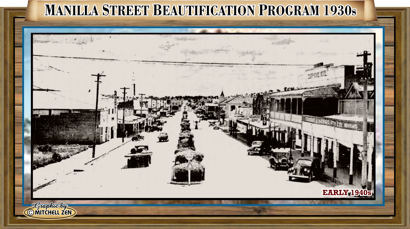
Development of the Manilla Street Beautification Program
In July 1930 Manilla’s Mayor, Ald. A. R. Macleod, moved in Council that the time was opportune for the consideration of a scheme of tar paving and beautification of Manilla business centre, Manilla Street.

The History of the Manilla Tigers Rugby League

The Manilla Tigers Rugby League Football Club was formed in 1917-18 after “Dally” Messenger, aged 34, and wife Annie, came to Manilla to take over the licence of the Royal Hotel.
He introduced the new code of Rugby League to the local Union players.
There were not many men available and some were enlisted into World War 1. Dally rounded up Jack Hiscox, Roy Blanch, Frank and Norman Chapman, Jack Munro, Ivan Miller and others, and played on the “Half Holiday” Wednesday

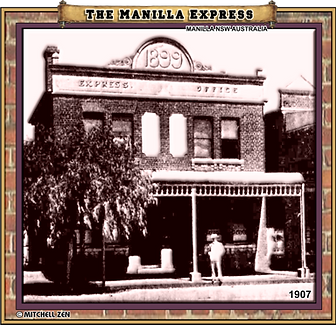
The History of the Manilla Express
The Manilla Express was founded by Arthur Vincent on behalf of the Vincent family in 1899, and has been going to print on a continual basis since that first published day on January 14th 1899.
The first edition was printed in premises opposite the Manilla Court House and soon after the business was set up in new brick premises opposite the first Mechanic’s Institute building.
On January 14th 1899, the first issue of the Manilla Express was published. The publisher being Henry Cleave Vincent, and editor Arthur E. Vincent. The company established their subscription pa rate and advertising rates, and fifty years on these charges have only slightly changed

The History of Mackenzies Stores

M. C. Mackenzie & Sons Pty. Ltd., Merchants and Importers, became a great commercial force, financially and influentially.
The first M. C. Mackenzie and Sons store opened in Aberdeen, NSW in 1863.
A hundred years later they had stores at Deepwater, Glen Innes, Manilla, Barraba and Upper Horton; Mackenzie Motors at Manilla and Glen Innes and the Glen Innes Brick and Tile Company.

The Mackenzie Store Fires

The Manilla Mackenzie’s Store Fires in 1914 and 1927; and their Furniture Store Fire in 1912.
The M. C. Mackenzie Store fire in Friday 13th March 1914 occurred shortly after the Royal Hotel fire in January 1914. The previous year the Mechanics Institute burnt down in October 1913 - on the other side of M. C. Mackenzie’s. Mackenzie’s escapes these two fires on those occasions.
The Manilla Express Newspaper Reports, on the occasion of these fires provides a vivid, personal and descriptive information for these events.

Mackenzie Shopping &
Store Staff 1950s-1960s

Manilla and Mackenzie’s Early 1960s
Manilla in the early 1960s was a vibrant community participating in a diverse range of activities, partly due to the influx of people for the Keepit Dam construction but also as a town that offered facilities and employment. Where affordable homes were built across the township from the mid to late 1950s into the 1960s.
At Mackenzies, there was a full staff of 40 plus, providing the necessary products for the Manilla Community to enjoy – even Beatle socks.
The Staff posed proudly in 1963 for an Historic 1963 Photograph.

Manilla Central School History
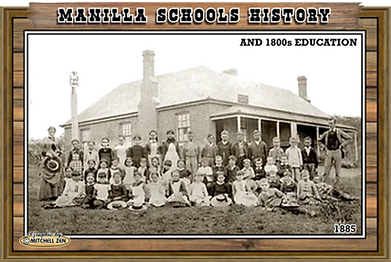
By the early 1870s a number of pioneer families had settled in Keepit, forming a nucleus of settlement that rivalled Manilla. Keepit was the first school in the Manilla district and opened in late 1875.
The school operated as a provisional school until 1880, then was upgraded to a primary school. When pupil numbers fell at various periods during the 1890s and early 1900s, the school became either a half-time school or a provisional school.
At this time the population of Manilla was 160 in 1877, where a school was also built in Upper Manilla. There was also a private school on the corner of Rowan and Strafford Streets Manilla in 1873.

Veness - Hartley - Hall Family Connections

A Study of the Relationships between the Hartley, Hall and Veness Families, and how their Collaboration Developed Manilla NSW during the Colonial 1800s.
David Hartley (Snr) (1783-1863) arrived in the Colony (Australia) as a convict on board the ship Duke of Portland on the 27th July 1807 (age 24). His crime was poaching from a noble’s property.
Frances (1814-1896) and Matthew Henry Hall (Snr) (1811-1888) gave birth to a son on the 4th September 1830, and was given the Hall name.
Emma is the daughter of George Veness (1823-1895), the founder of Manilla, and his wife Mary Sarah (nee Fegan) (1824-1907). David gave his occupation as sheep overseer from Hall’s Creek (just east of Manilla). Emma and David had five children.


