


Panoramic View - Best viewed on a Laptop/Desktop
INDEX (6)

Droving in Manilla 1930s
Prior to 1933 Vincent J. Byrnes, a successful Stock and Station Agent in Manilla, sought the services of an experienced stockman by the name of Mr L. Squires to move 11,000 sheep from Thirlogoona Station in Queensland – 200 hundred miles north of the border. It was an epic journey over a period of four months.
Edwin Montague Embury was a teacher at the Manilla Rural School during the 1930s,
and spoke to the head drover in charge of the flock - Mr L. Squires.
A fascinating insite into droving in the 1930s Australia


Mackenzie Centenary Celebrations 1863-1963

The successful development of the M. C. Mackenzie Company was challenging and not without hardships. But with determination, a desire to succeed, and an acumen for business management, the Mackenzie Company provided much needed services during our early Australian Colonial years and this continued during the 1900s.
After 100 years of successful trading, in 1963, M. C. Mackenzie & Sons Pty. Ltd celebrated this achievement with a “Centenary of Progress over 100 years.”
This is their story

The Manilla Palais Theatre

The Manilla Palais Theatre was officially opened on Saturday night the 20th October 1928 with almost a full house of 800. With over 2,000 residents already connected to electricity, the number indicated the popularity of the newly established Palais theatre.
The Palais became enjoyment for the Manilla district for a number of decades, where movies developed from Silent to Talkies, through to big Productions in full colour. It was a time of excitement and wonder.
The article has many pictures and links to the movies of the era of The Manilla Palais Theatre - enabling you to go back in time.

Lieutenant John Oxley - Explorer and NSW Surveyor General

John Oxley enlisted in the Navy at 15 years of age, travelling to Australia and explored our vast continent. Gathering information as a Surveyor and reporting this information back to Sydney that enabled the development of Australia and in particular the north west area of the Tamworth and Manilla District.
This article is a fascinating look into Oxley's exploration in 1818 and includes many pictures

Clifton and Woods Garages

Cliftons Garage originally started in Barraba and opened up their Manilla Garage in the 1920s.
They also sold a range of vehicles over the years, including Oakland, Pontiac, Chevrolet, Chamberlain, Austin, Bedford and Holden.
By 1953, John Wheeler was the foreman at Clifton’s Garage, and had married Doris just three years earlier in 1950. Doris branched out and took on the franchise and lease of Woods Garage, which at the time was on the other side of the street.
Coming Soon
The Success of J.T. Robertson and A.E. Coupland

J. T. Roberton and Co. opened for business in 1903, and took into partnership A. E. Coupland, who had charge of the Manilla section of the business. When Robertson died in 1907, Coupland bought the business, but continued to trade under the old name, which still existed 70 years later.
They were Forwarding Agents, Produce Merchants and a General Carriers, and played a crucial role in coordinating transportation, handling documentation, and ensuring the smooth flow of cargo from the pastoral industry.
As time went by they branched out selling a variety of products eventuating in obtaining the International Harvester agency.

Tobacco Farming in Manilla

Tobacco use in Australia dates back to the early 1700s, with Indonesian fishermen introducing it to the Indigenous communities - before British settlers brought their own patterns of use.
Chinese farmers were pioneers of tobacco growing. By 1891 there were 464 growers in NSW and Victoria. Manilla was a centre of tobacco growing during the early 1900s, and tobacco was also grown at Nundle. Nundle is just 100klms south of Manilla.
An experimental plot of tobacco was also grown by a Chinese farmer at Halls Creek (a few kilometres east) in 1896 produced some good quality leaf, where the crop was a marketable success. Others were along the Manilla River and the Namoi and also at Keepit.
Coming Soon
The Manilla Freezer Works

The Freezing Works at Manilla was an Important Contributor to Progress
After Scotsman, James Harrison, invented the world’s first commercially viable, ice-making machine in the 1800s, the first Freezing Works in Manilla were built at the corner of Burrell and Arthur Streets in late 1916. T. A. Sampson owned the first Manilla Freezing Works, along with the Rabbit Processing Works at Homebush in Sydney.
Rabbits were frozen at the freezer works to facilitate a profitable export trade and to provide a source of income during economic downturns, and provided a valuable food source and became a significant employer of labour in rural Australia - their skins were also used in the fur trade.
Coming Soon
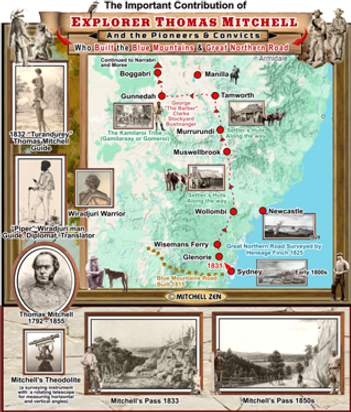
The Explorer Thomas Mitchell
Thomas Livingstone Mitchell was born at Craigend, Stirlingshire, Scotland, on 15 June 1792. His father died when he was still young,
He arrived in Australia in 1827, when the estimated population was 56,000; when he died in 1855 it was 793,000: and the type of population had completely changed. In 1827 the people of the colony were the official autocracy, the squatter autocracy (exclusives), convicts, emancipists, and a limited number of free immigrants.
He was a Surveyor General he was responsible for all matters such as disposal of Crown lands, of survey of boundaries of alienated land, of titles, supervision of lease-hold tenures, and all related matters, over a territory from Bass Strait to the middle of Queensland.
He exployed many areas of NSW, including the area around Tamworth and Manilla, and this article with pictures articulates his life in this area.
Coming Soon


